How to Calculate Board Feet: Lumber Formula & Quarters Guide
Published: September 20, 2026 • Written by Master Carpenter Jack Mercer • Fact Checked
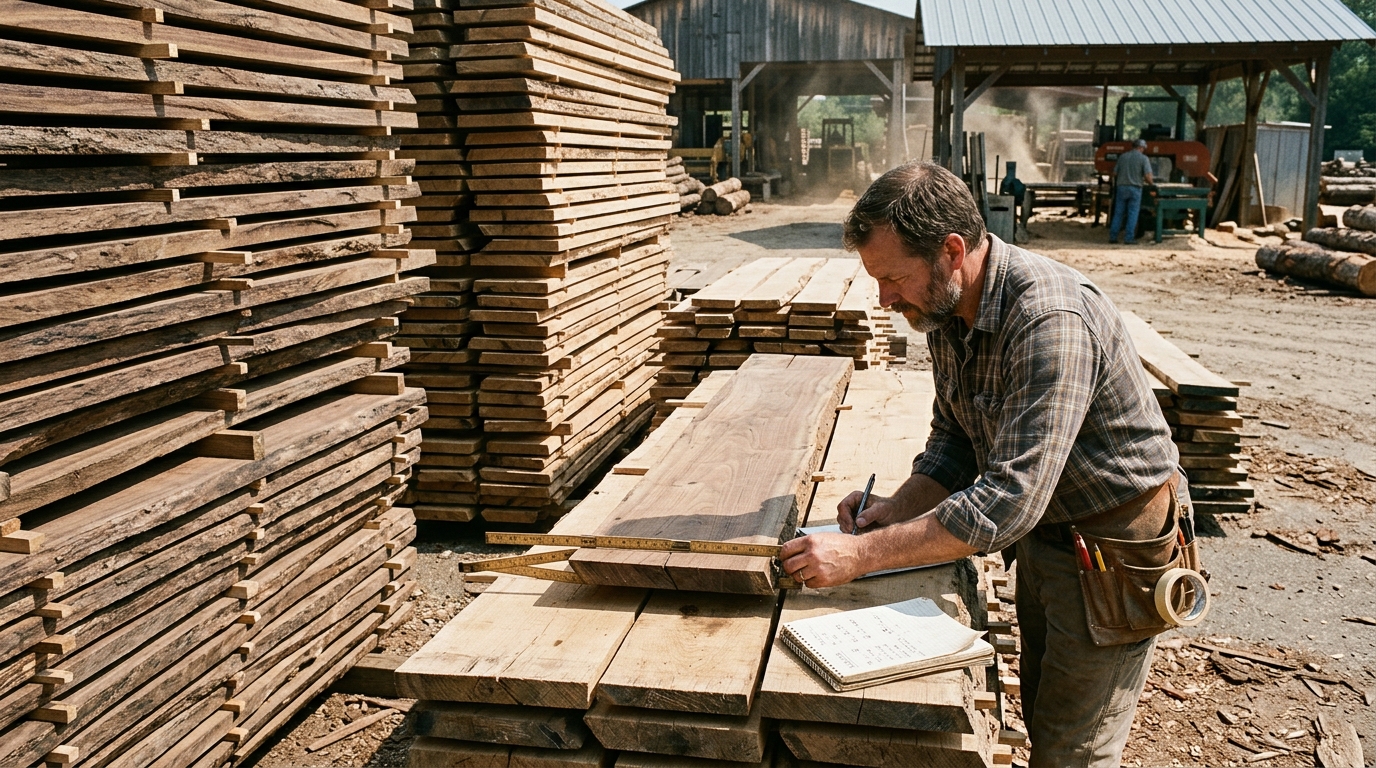
Walking into a hardwood lumberyard for the first time can be intimidating. Unlike big-box home improvement centers where softwood 2x4s and 1x6s are sold by the linear foot or piece, hardwood species like black walnut, hard maple, white oak, and cherry are sold strictly by the board foot (BF).
A board foot is a three-dimensional volumetric measurement, not a surface area. Understanding how to calculate board footage and decode sawmill "quarters" thickness ratings ensures you purchase the exact lumber needed for dining tables, cabinets, and custom joinery without overpaying.
What Exactly Is a Board Foot?
By definition, one board foot equals 144 cubic inches of solid wood. The classic mental model is a board that measures:
1 inch thick × 12 inches wide × 12 inches (1 foot) long = 144 cubic inches = 1 Board Foot (BF)
The Two Board Foot Formulas
Depending on whether your board length is recorded in inches or feet, use one of the two standard sawmill formulas:
Formula A (When Length is in Feet):
Board Feet = [ Thickness (in) × Width (in) × Length (ft) ] ÷ 12
Example: A 2" thick × 6" wide × 8 ft long board = (2 × 6 × 8) ÷ 12 = 96 ÷ 12 = 8.0 Board Feet.
Formula B (When All Dimensions are in Inches):
Board Feet = [ Thickness (in) × Width (in) × Length (in) ] ÷ 144
Example: A 1.75" thick × 8.5" wide × 42" long board = (1.75 × 8.5 × 42) ÷ 144 = 624.75 ÷ 144 = 4.34 Board Feet.
Decoding Sawmill "Quarters" Thickness
Hardwood sawmills measure rough-sawn lumber thickness in quarter-inch increments, written as a fraction over 4:
| Lumber Quarter Rating | Rough-Sawn Thickness | Final Surfaced Thickness (S2S) | Common Project Uses |
|---|---|---|---|
| 4/4 ("Four-Quarter") | 1.00" to 1.125" | 3/4" (0.75") | Cabinet face frames, drawer boxes, shelving, small boxes. |
| 5/4 ("Five-Quarter") | 1.25" to 1.35" | 1.00" (1.00") | Stair treads, solid passage doors, substantial desktop surfaces. |
| 6/4 ("Six-Quarter") | 1.50" to 1.60" | 1-1/4" (1.25") | Dining table tops, chair legs, heavy bench framing. |
| 8/4 ("Eight-Quarter") | 2.00" to 2.20" | 1-3/4" (1.75") | Butcher blocks, dining table legs, turning stock, exterior doors. |
Surfacing Loss: Why You Must Add 15% to 25%
Rough-sawn lumber comes off the sawmill blade with rough fuzzy faces, minor cupping, and slight twists from the kiln-drying process. To turn rough wood into flat, square lumber, you must face-joint it flat and run it through a thickness planer.
Planers remove between 1/8" and 1/4" of wood thickness. Furthermore, boards will contain bark edges (wane), end checks (splits from drying), and sapwood that must be ripped away. Always add 15% to 20% waste allowance for straight grain projects, and 25% to 30% waste for curved furniture parts.
Lumber Yard Etiquette: How to Buy Like a Pro
- Bring your cut list and a tape measure: Know the minimum lengths and widths you need so you don't purchase boards that are too short to yield your parts.
- Always restack lumber piles: If you dig through a lumber stack to find boards with exceptional figure or grain, carefully restack the rejected boards neatly with spacer stickers intact.
- Understand FAS vs Select vs #1 Common: "FAS" (First and Seconds) yields 83% clear cuttings on both faces. If you are building rustic furniture or staining dark, #1 Common costs 40% less and provides plenty of usable wood.