The Woodworker's Guide to Fractional Math
Published: June 3, 2026
One of the biggest hurdles in DIY framing and woodworking isn't the physical cutting or assembly—it's the mental math. Adding, subtracting, or dividing tape measure fractions on the fly is a notorious source of mistakes. If you have a board that is 14 5/8" and need to add 3 11/16", doing that in your head requires converting denominators, finding least common multiples, and reducing the result.
In this guide, we'll teach you the simple mental shortcuts for managing fraction math, and provide a visual calculator to do the work for you.
Understanding Denominators on a Tape Measure
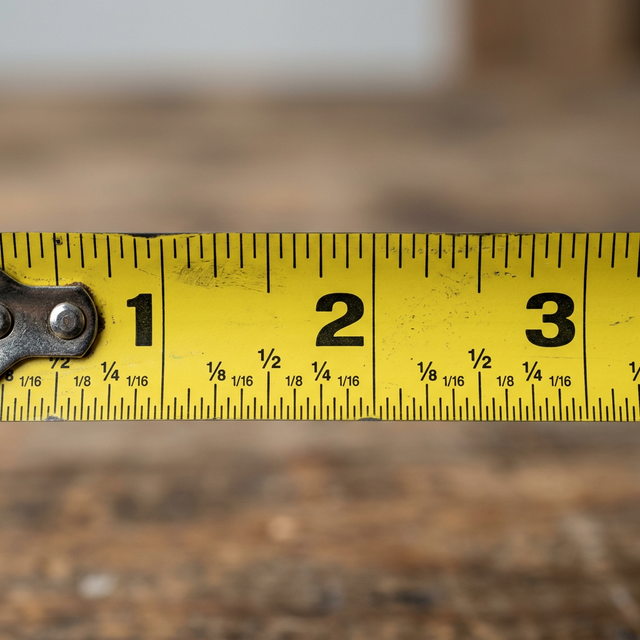
All fractions on a standard Imperial tape measure use denominators that are multiples of 2: 2 (halves), 4 (quarters), 8 (eighths), and 16 (sixteenths). Sometimes, finer scales include 32 (thirty-seconds).
To perform any addition or subtraction, you must first convert the fractions to have the **same denominator**. For example, if you are adding 1/8" and 1/16", you must convert 1/8" into sixteenths: 2/16". Once the denominators match, you simply add or subtract the numerators.
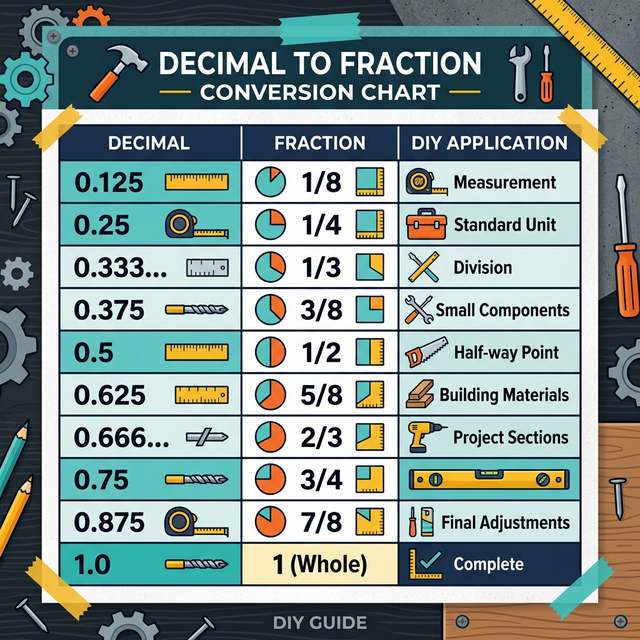
Quick Conversion Cheat Sheet:
- 1/2" = 2/4" = 4/8" = 8/16"
- 1/4" = 2/8" = 4/16"
- 3/4" = 6/8" = 12/16"
- 1/8" = 2/16"
- 3/8" = 6/16"
- 5/8" = 10/16"
- 7/8" = 14/16"
Mental Shortcuts for Adding Fractions
If you don't have our calculator handy, follow these steps to add tape measurements quickly:
- Add the Whole Inches First: If you are adding 5 3/8" and 4 7/8", add 5 + 4 = 9 inches. Set that aside.
- Add the Fractions: Add 3/8 + 7/8 = 10/8.
- Convert Improper Fractions: 10/8 is 1 2/8 (since 8/8 = 1).
- Reduce the Remainder: 2/8 reduces to 1/4. So the fractional sum is 1 1/4".
- Combine: Add the fractional sum to the whole inches sum: 9 + 1 1/4 = 10 1/4".
How to Easily Divide a Measurement in Half
Finding the exact center of a board is a daily task in carpentry. Here is the easiest way to divide any fractional measurement in half:
If the whole number is Even:
Simply take half of the whole number and double the denominator of the fraction.
Example: Half of 12 3/8" → Half of 12 is 6, double 8 is 16 → 6 3/16"
If the whole number is Odd:
Subtract 1 to make it even. Find half of that even number. Then add the numerator to the denominator to get the new numerator, and double the denominator.
Example: Half of 7 3/8" → 7 becomes 6 (half is 3). New numerator: 3 + 8 = 11. Double denominator: 16 → 3 11/16"