Laser Distance Measurers vs Tape Measures: Accuracy & Field Guide
Published: September 20, 2026 • Written by Master Carpenter Jack Mercer • Fact Checked
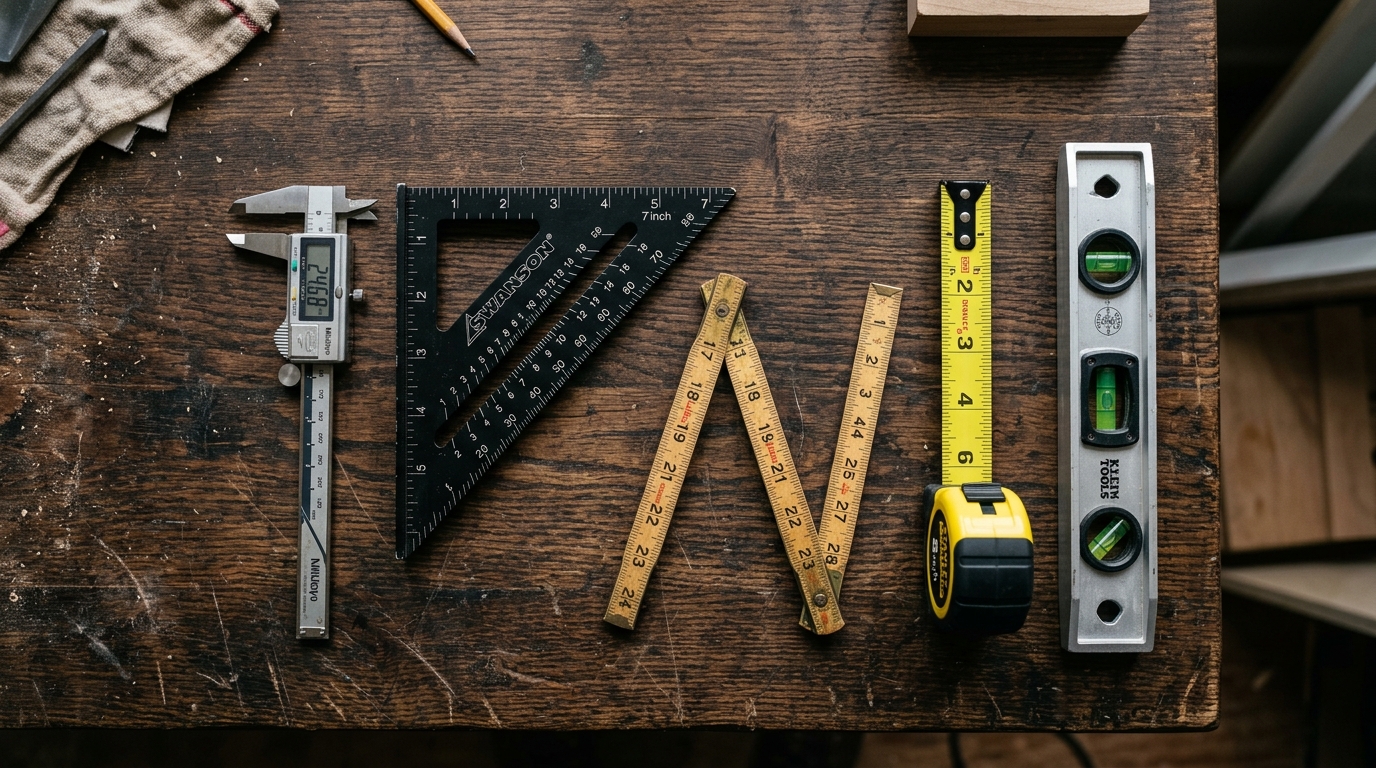
For over a century, the spring-steel tape measure has reigned as the undisputed king of layout tools. But over the last decade, handheld laser distance meters (LDMs) have become affordable, compact, and ubiquitous among appraisers, architects, flooring installers, and remodelers.
Can a laser measurer completely replace a physical tape? Or does each tool have distinct physical boundaries where one triumphs over the other? Here is a technical breakdown grounded in optics, geometry, and real jobsite conditions.
How Laser Distance Meters Work
Unlike simple ultrasonic distance meters that bounce audio pulses off walls (which suffer from wide beam divergence and air temperature inaccuracies), professional laser measurers use optical phase-shift modulation or time-of-flight (ToF) calculation.
Optical Precision: The tool emits a focused pulse of laser light (Class II, typically 635 nm red or 515 nm green). By comparing the phase difference between the outgoing and reflected wave, the internal microprocessor calculates distance with a typical accuracy of ±1/16" (1.5 mm) over distances up to 165 to 300 feet.
Side-by-Side Comparison: Laser vs Tape Measure
| Feature | Laser Distance Measurer | Physical Steel Tape Measure |
|---|---|---|
| Long Spans (20–150 ft) | Effortless 1-person operation; no blade sagging or collapsing. | Requires two people; tape sags, introducing catenary curve error. |
| Short Spans (< 3 ft) | Awkward; minimum distance limit (often 6 inches); needs a target wall. | Fast, instantaneous, flexible; easy to mark short cut lines directly. |
| Outdoor Sun Visibility | Difficult; bright sunlight washes out red laser dot past 30 feet. | Always 100% visible regardless of solar glare. |
| Scribing & Marking Cuts | Cannot be used as a physical straightedge or cutting guide. | Can hook onto board edge and guide a pencil to scribe rip cuts. |
| Durability & Power | Sensitive optical lens; requires working batteries. | 100% mechanical; impervious to dead batteries, mud, and dust. |
3 Advanced Laser Modes Every Pro Uses
- Indirect Pythagorean Measurement: Need to measure the height of a 2-story building exterior without climbing a ladder? Aim the laser at the roof peak, then at the base foundation. The internal sensor uses the Pythagorean theorem (A2 + B2 = C2) to calculate the vertical wall height automatically.
- Continuous Live Tracking: Walk backward away from a wall while the laser actively updates dimensions in real-time, allowing you to stop precisely at 10'-0" to set a wall partition or furniture placement.
- Instant Area & Volume Accumulation: Measuring two adjacent walls immediately calculates square footage, while taking a third ceiling height reading yields cubic footage for HVAC duct sizing.
The Verdict: Which Should You Carry?
Professional tradespeople do not view lasers and tape measures as competitors—they are complementary tools. Keep a compact laser measurer in your pocket for estimating room dimensions, quoting flooring, and taking long hallway measurements alone. Keep a durable 25-foot tape measure on your belt for marking cut lists, framing studs, and scribing lumber.