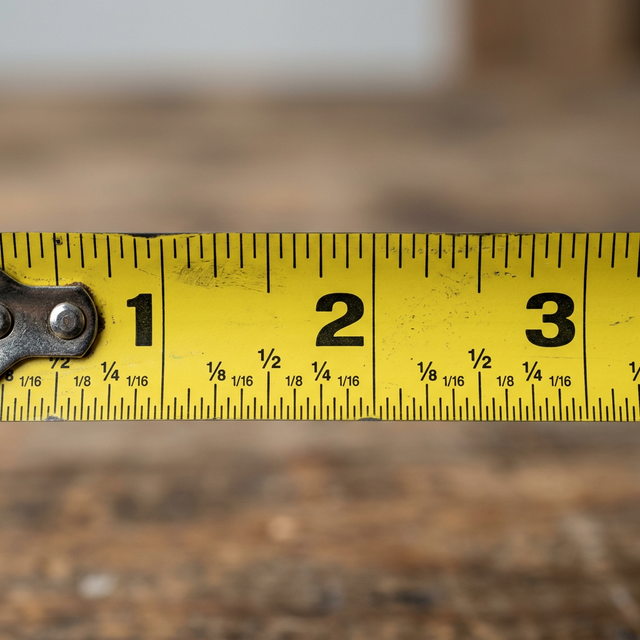
5 Common Measuring Mistakes and How to Avoid Them
Published: May 24, 2026
The old saying "measure twice, cut once" is famous for a reason. In woodworking, DIY projects, and home construction, a single mismeasurement of just 1/16th of an inch can ruin a piece of wood, waste hours of labor, and cost you money in wasted materials.
Interestingly, most measurement errors aren't caused by a lack of math skills; they are caused by bad habits or a misunderstanding of how measuring tools work. Here are the 5 most common measuring mistakes and how to avoid them.
1. Misunderstanding the Wobbly Metal Hook
The metal hook (the "tang") at the end of a tape measure is intentionally loose and wiggles back and forth. Many people think it's broken and try to tighten the rivets with a hammer. This ruins the tape!
The hook slides exactly the thickness of the metal blade. When you hook it over the edge of a board (outside measurement), the hook pulls out to account for its own thickness. When you push it against a wall (inside measurement), it slides in. If you hammer the rivets tight, all your measurements will be off by about 1/16" depending on whether you push or pull.
2. The "Burning an Inch" Trap
When measuring small items or checking cuts, woodworkers will often "burn an inch" (starting the measurement at the 1-inch mark instead of the zero hook) because the zero end hook can be slightly inaccurate or awkward to position.
The trap occurs when you mark your wood. Because you started at 1 inch, you must add 1 inch to your target dimension. If you need a 10-inch board, you must cut at the 11-inch mark. Far too often, builders forget they are burning an inch and cut at the 10-inch mark, resulting in a board that is exactly 1 inch too short!
3. Parallax Error (Viewing Angle)
Parallax error occurs when you look at the tape measure markings from an angle instead of directly from above. Because the tape blade sits slightly above the surface of the wood, looking at it from the side shifts your line of sight, causing you to mark the wood slightly left or right of the true line.
4. Cumulative Errors (Measuring in Steps)
If you need to mark several segments on a long board (for example, marking stud locations or shelving supports), you might be tempted to measure each segment individually: measure 12", mark it, place the hook on the new mark, measure 12", mark it, and so on.
This is a major mistake. Every time you make a pencil mark, you introduce a tiny error (often 1/32"). By the time you do this 5 or 6 times, your final mark could be off by 1/4" or more due to "error accumulation."
5. Using the Wrong Pencil Mark
Drawing a thick, blunt line with a builder's pencil is a fast way to ruin precision cuts. A standard pencil line can be up to 1/16" thick. If you cut on the wrong side of that thick line, your piece will be too short or too long. Also, drawing a simple straight dash can lead to confusion about where the exact point of the line is.
If you're ever in doubt about what a specific measurement looks like on the tape, search for it using our TapeVisualizer to see it mapped out clearly and remove the guesswork!