Beyond the Tape: 5 Measuring Tools Every Homeowner Needs
Published: April 22, 2026
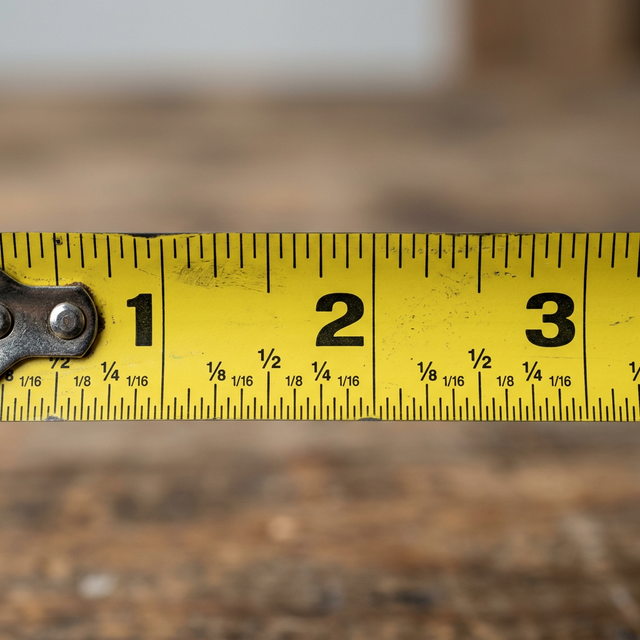
The standard 25-foot retractable tape measure is the undisputed king of the toolbox. It's versatile, cheap, and gets the job done 90% of the time. But what about that other 10%? What happens when you need to hang a gallery wall perfectly straight, or measure the exact thickness of a pipe?
Relying solely on a tape measure for every task is like using a hammer to drive a screw. To tackle serious DIY projects, you need to expand your measurement arsenal. Here are the 5 essential measuring tools you need beyond the standard tape.
1. The Laser Measure
If you've ever tried to measure the length of a long hallway by yourself, watching the tape measure bend, snap, and retract violently at the last second, you need a laser measure.
A laser measure calculates distance by sending out a pulse of laser light to a target and measuring the time it takes for the reflection to return. They are incredibly accurate (usually to within 1/16th of an inch) over massive distances (up to 300 feet for high-end models).
Best for: Estimating paint or flooring (they automatically calculate square footage!), measuring high ceilings, and any task where spanning a physical tape is difficult or requires two people.
2. The Digital Caliper
A tape measure is designed for macro-measurements. When you need micro-precision—like finding the exact diameter of a drill bit, measuring the thickness of a piece of sheet metal, or identifying a replacement screw—you need calipers.
Digital calipers can measure outside dimensions (thickness), inside dimensions (the width of a hole), and depth. They display the exact measurement on an LCD screen down to a thousandth of an inch (0.001").
Note: If you are using digital calipers that display in decimals (e.g., 0.375") and need to convert that to a tape measure fraction, check out our Decimal to Fraction Conversion Chart.
3. The Speed Square (Rafter Square)
Despite its name, the speed square isn't just for checking if a corner is exactly 90 degrees (though it does that exceptionally well). It is the most versatile measuring tool in a carpenter's pouch.
- As a guide: You can hold it against a board to guide your circular saw for perfectly straight cuts.
- As a protractor: It has degree markings along the hypotenuse, allowing you to easily mark and cut angles.
- As a scribe: It features notches spaced 1/4" apart, allowing you to drag your pencil along a board to mark a perfectly parallel line.
4. The Laser Level (Self-Leveling)
Measuring distance is only half the battle; measuring "level" (horizontal) and "plumb" (vertical) is the other half. Traditional bubble levels are great, but for large projects, a self-leveling laser is game-changing.
These devices project a perfectly straight, perfectly level beam of light across an entire room.
Best for: Hanging a gallery wall of picture frames, installing kitchen cabinets, putting up chair rail molding, or tiling a shower. You simply set the laser on a tripod, and you instantly have a perfectly level reference line across all four walls.
5. The Combination Square
The combination square features a rigid steel ruler (usually 12 inches) with an adjustable head that slides along it. The head has a 90-degree edge and a 45-degree edge.
Because the head can be locked at any point along the ruler, it is the ultimate tool for transferring measurements. If you need to mark exactly 1 3/8" from the edge of a board in ten different places, you lock the combination square at 1 3/8", and simply use it as a repetitive marking gauge.
Conclusion
A good tape measure is foundational, but it has its limits. By adding a laser measure for long distances, calipers for micro-precision, squares for angles, and a laser level for layout, you will dramatically increase the speed, accuracy, and professional quality of your DIY projects.